
Leach Field vs Drain Field: What Is the Difference?
There is no difference. A leach field and a drain field are the same part of a septic system. Drainfield and soil absorption field are two more names for it. North Carolina’s septic rules call it the dispersal field.
Whatever the name, it is the buried area where liquid from your septic tank soaks into the soil. When a leach field fails, the usual quote is to replace it. Septic Samurai’s drain field restoration works from inside the tank you already own, so the field stays in the ground.
What other names mean the same thing as a leach field?
The EPA uses three of them on one page. It says a typical system has a septic tank and a drainfield, or soil absorption field. The liquid flows into perforated pipes buried in a leach field, and the EPA calls this area the drainfield.
NC State Extension writes drainfield as one word. North Carolina’s rules (15A NCAC 18E .0105) say dispersal field: the place where final treatment and dispersal of effluent occurs. The table sorts out the names and the parts.
| Name | Where you see it | What it means |
|---|---|---|
| Drain field or drainfield | The EPA and NC State Extension | The buried area that takes the liquid leaving the septic tank |
| Leach field | The EPA | The same area; the EPA uses both names |
| Soil absorption field | The EPA | The same area, where the soil takes in and treats the liquid |
| Dispersal field | North Carolina’s septic rules (15A NCAC 18E .0105) | Where final treatment and dispersal of effluent happen |
| Trench | North Carolina’s septic rules | A dug channel no more than three feet wide that holds the pipe and its media |
| Lateral | North Carolina’s septic rules | A pipe or tubing that carries effluent through the field: the drain line |
| Dispersal media | North Carolina’s septic rules | Washed gravel, crushed stone or an approved product with open space for effluent |
| Biomat | NC State Extension and the EPA | A layer in the top 1 to 6 inches of soil under the trench bottom |
| Repair area | NC State Extension | Land kept open for a replacement system, in case one is ever needed |
How does a leach field work?
All the water from your house runs through one main drain pipe into the septic tank. There, solids settle to the bottom as sludge, and grease floats to the top as scum. After about two days, the liquid, called effluent, flows out to the field.
In the field, effluent runs into perforated pipe in the trenches and out through the holes. Then it trickles down through the gravel to the soil, per NC State Extension. The EPA calls the field a shallow, covered excavation made in unsaturated soil.
The soil does the real treatment, NC State Extension says. The EPA says the soil accepts, treats and disperses the wastewater as it percolates down.
NC State Extension puts a family of four at 200 to 250 gallons of sewage a day. It says a site with clayey, slowly permeable soils needs a larger drainfield.
What kinds of drain field trenches are used in North Carolina?
NC State Extension describes two kinds of conventional trenches: gravel and gravel-less. Either way, it is still the drain field.
Gravel trenches. A perforated pipe, which the rules call a lateral, sits in washed gravel or crushed stone. North Carolina’s rules define a trench as an excavation no more than three feet wide.
Gravel-less trenches. These swap the stone for another material. NC State Extension lists plastic louvered chambers, polystyrene aggregate, tire chip aggregate and large diameter pipes. Each one leaves open space in the trench so effluent can reach the trench bottom.
NC State Extension says some sites need pumps and a pressure manifold, low-pressure pipe (LPP) or drip irrigation. North Carolina’s rules count a pump, pump tank or distribution box as part of the dispersal system.
What is the biomat, and how does a leach field fail?
The biomat forms in the upper 1 to 6 inches of soil, just below the trench bottom. A thin biomat is normal and useful, NC State Extension says, because it helps remove many germs and chemical pollutants.
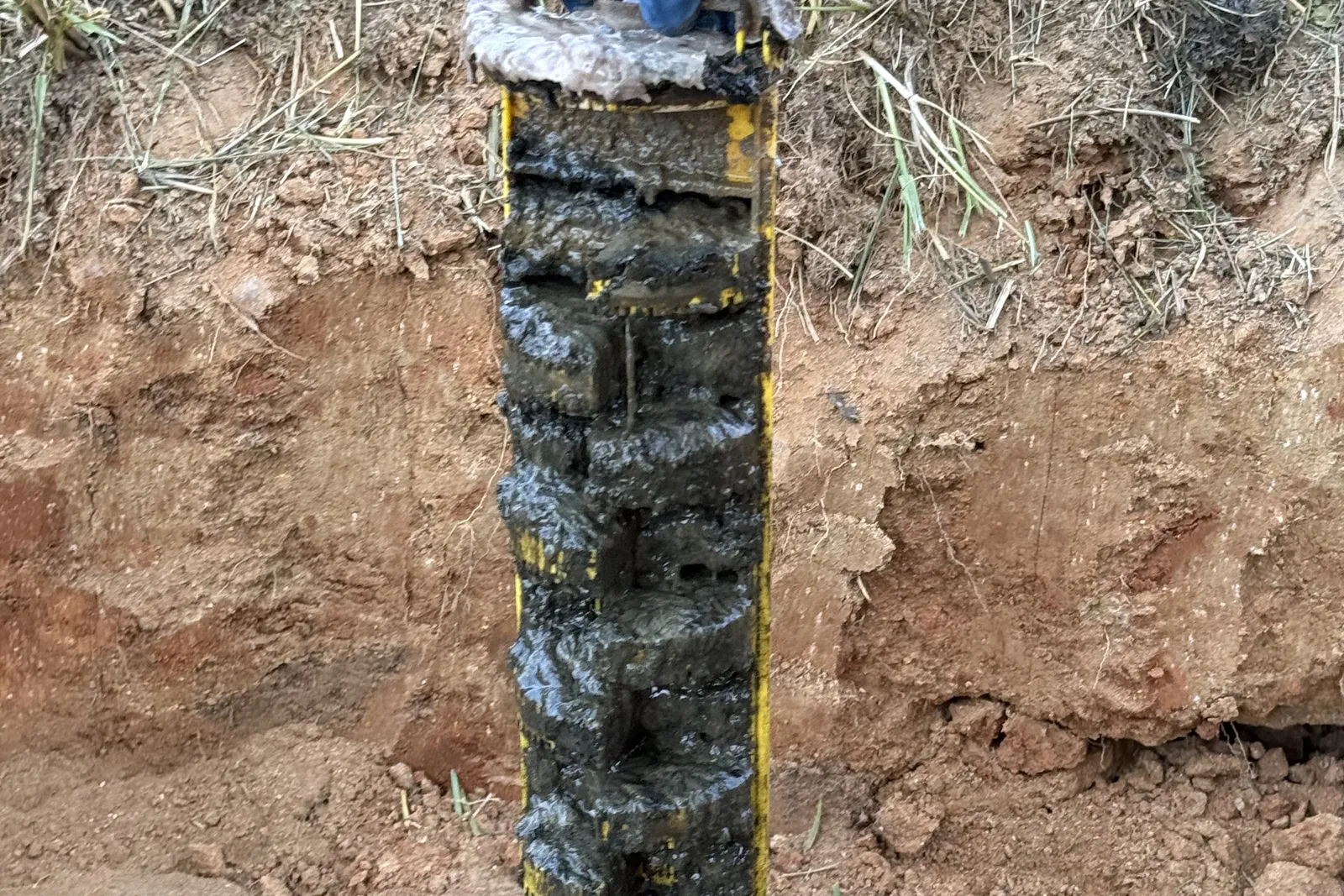
Trouble starts when solids leave the tank. NC State Extension says solids can flow into the trenches and build a biomat that becomes too thick. Then the biomat completely clogs the soil, and effluent cannot flow out of the trench. That thick biomat is the black, slimy layer that seals the ground around the drain lines.
The EPA says a drainfield more than 25 to 30 years old can see its natural biomat thicken. That can cause ponding in the field, untreated wastewater on the surface, or backups into the house.
Water and grease speed it up. The EPA says an overloaded drainfield can flood. Sewage can then reach the ground surface or back up into toilets and sinks. NC State Extension warns that grease can clog soil pores completely and ruin the drainfield.
In the house and yard, the signs are slow drains, gurgling, wet spots, odors and backups. An effluent filter on the tank outlet keeps undigested solids out of the field.
What can you do when a leach field fails?
Pumping the tank. NC State Extension says pumping after the drainfield is completely clogged will not rejuvenate the system. It buys only a few days until the tank fills again. Septic Samurai does not pump tanks; we refer pump-outs to a pumping company.
Replacing the field. A completely clogged field usually needs a new drainfield, an advanced pretreatment unit or both, NC State Extension says. The new field may go on a different part of the lot, in the repair area. NC State Extension warns this can be hard on your landscaping and yard. Septic Samurai does not replace drain fields; we refer that work out.
In North Carolina, a repair starts with an application to the local health department, under 15A NCAC 18E .0202. For market prices, see what drain field replacement costs in North Carolina.
Restoring the field. Drain field restoration goes after the biomat and leaves the field in place. We install an aeration and bacteria unit inside your existing septic tank, through its access opening. A small, quiet air pump outside the tank pushes air through a fine-bubble diffuser in the unit.
Natural aerobic bacteria on the unit’s growth media digest the organic solids in the tank. The treated effluent carries them into the field, where they digest the biomat. As the biomat breaks down, the soil absorbs water again.
Most installs are finished in a day. The only digging is a shallow air line from the pump to the tank, located through NC 811 first. We tell you before work starts if your county health department needs to be involved.
How do you find out which part of the system is failing?
Slow drains and wet spots tell you something is wrong. They do not tell you which part failed. Septic Samurai starts with a free on-site evaluation, and we look at the tank and the field first. A septic system inspection finds the cause and shows whether restoration fits your system.
We do not do real-estate inspections; in North Carolina those need a state-certified inspector.
Based in Statesville, Septic Samurai serves homes within about 50 miles, including Lake Norman and High Rock Lake. See how drain field restoration works, or call or text (980) 291-3805.