
Do Septic Tank Additives Work? Additives vs Aeration
No, not by the published research. NC State Extension asks whether septic tank additives are necessary, and answers “No.” Research to date on three types of bacterial additives has not shown solids building up any slower. It has not shown more bacterial activity in the tank either.
The EPA’s onsite wastewater treatment manual reaches the same verdict. It says additives are neither required nor recommended for a septic system. Some might damage the drainfield or contaminate the groundwater below it.
Septic Samurai takes a different approach. We install a septic aeration system inside the septic tank you already own, then service it on a schedule.
What do septic tank additives claim, and what does the research say?
Septic tank treatment products fall into three groups, NC State Extension says. Biological products carry bacteria, enzymes or yeast. Chemical products carry acids and bases, or organic chemicals such as solvents. The EPA manual also covers products sold to control septic odors.
| Additive type | What it is sold to do | What NC State Extension and the EPA say | The risk |
|---|---|---|---|
| Bacteria, enzyme or yeast packets | Cut sludge and scum buildup in the tank | NC State: research to date shows no slower solids buildup. EPA: not recommended, since wastewater already carries these organisms | Some studies suggest it adds solids to the water headed for the drain field |
| Acids and alkalis | Open clogged drains | EPA: can upset the breakdown of waste in the system | Structural damage to pipes and septic tanks |
| Organic solvents | Break down oils and grease | EPA: a significant risk to groundwater, and banned in many states. NC State: may damage the drainfield | Can kill off helpful microbes and reach groundwater and nearby wells |
| Odor killers | Control septic odors | EPA: they work by killing bacteria, which runs counter to how a septic tank works | The smell can mean surfacing sewage or a broken line, and the EPA says to find the source |
Some biological additives have been found to break down or disperse scum and sludge, the EPA manual notes. Whether that relatively minor benefit comes without harm to the drain field over time has not been shown conclusively. NC State Extension’s bottom line is that additives do not seem to reduce the need for regular pumping.
Why don’t septic tank bacteria and enzyme products do more?
The EPA’s answer is that the tank already has what these products sell. Typical household wastewater carries many kinds of bacteria, enzymes, yeasts and other microorganisms. Biological additives mirror the breakdown already under way, and they do not appear to speed it up much.
Yeast in a septic tank belongs to the same group, since NC State Extension lists it with the biological additives. The EPA manual says these products are not necessary for a septic tank to work properly on household wastewater. Studies of their effectiveness have failed to prove they are worth the cost for homes.
What actually keeps a septic system working?
Pumping when the tank measures out. North Carolina sets the pumping point in rule 15A NCAC 18E .1303. The tank gets pumped when scum and sludge fill more than one third of the liquid depth. For timing by household size, see how often to pump and service a septic tank. Septic Samurai does not pump tanks, so we refer that job to a pumping company.
Keeping the wrong things out. NC State Extension says grease hardens in the tank. Grease that flows through with hot water can clog the soil and ruin the drainfield. Household chemicals such as paint thinners and pesticides may kill the tank’s helpful bacteria. For a clogged drain, the EPA says to skip chemical drain openers and use boiling water or a drain snake.
An effluent filter. The filter sits on the tank outlet and keeps undigested solids out of the drain field. Most older tanks never had one, because there was no riser access to service it. Septic Samurai installs an effluent filter on the tank outlet and cleans it on every service visit.
Routine upkeep has a cost of its own. Published market ranges are in what septic tank maintenance costs in North Carolina.
How is in-tank aeration different from a septic system treatment?
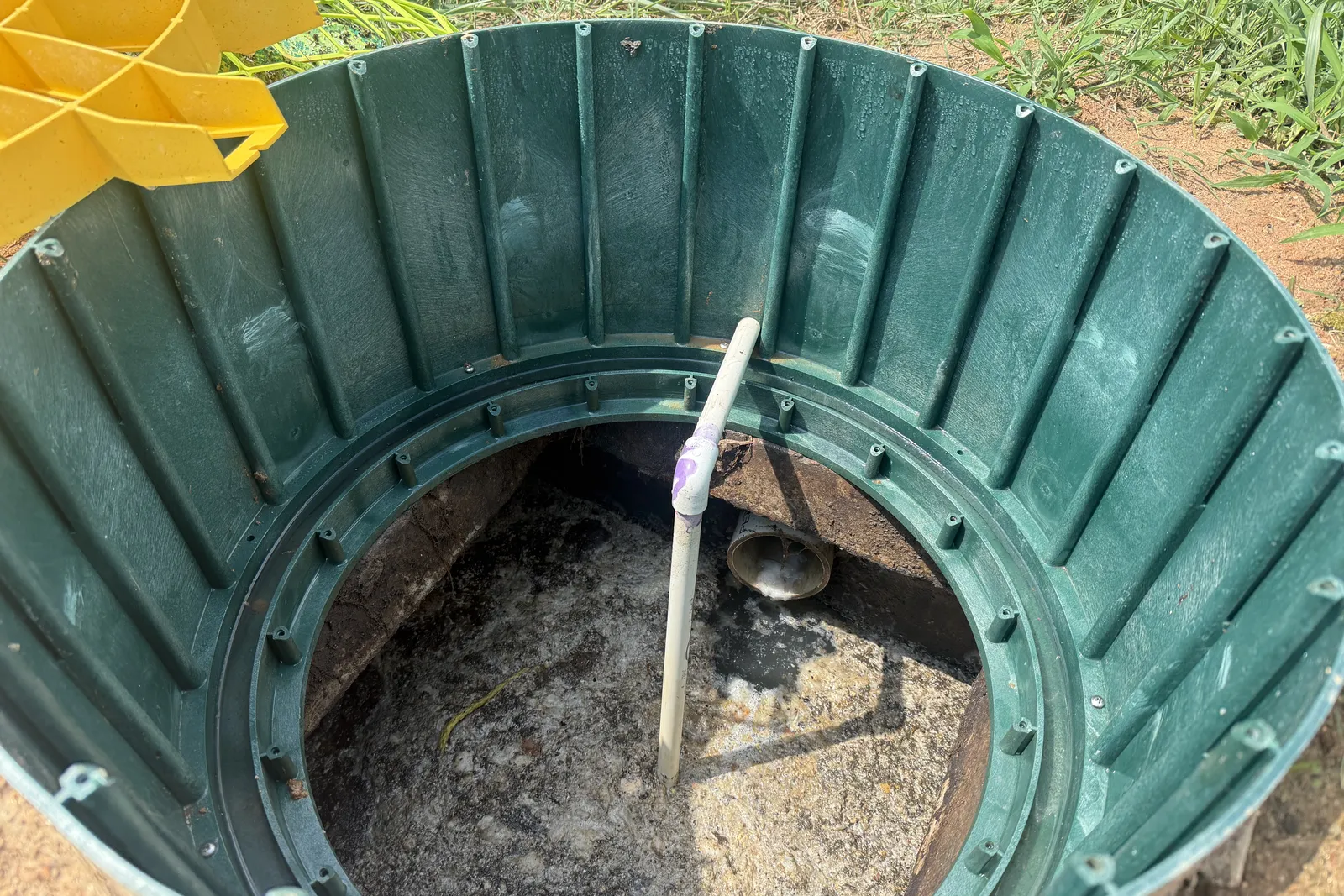
Septic Samurai installs a compact aeration and bacteria unit inside the existing septic tank, through its access opening. A small, quiet air pump outside the tank pushes air through a fine-bubble diffuser in the unit. The unit carries growth media colonized by a blend of natural aerobic bacteria. Most installs are finished in a day, and the drain field is not dug up.
With oxygen, those bacteria digest the organic solids in the tank. The treated effluent then carries them into the drain field, where they digest the biomat. That is the black, slimy layer of organic build-up that clogs the soil around the drain lines. This step is what drain field restoration is built on.
The difference from an additive is the setting. A store-bought packet goes into a tank with no oxygen supply, and nobody checks on it afterward. Our bacteria treatment is added on service visits, to a system with an air supply, a filter and a schedule. The NC State and EPA findings above are about additive products.
An effluent filter on the outlet keeps undigested solids out of the field, and the unit has a high-water alarm. Year one comes with the install: three visits, at about 30 days, 6 months and 1 year. Each visit checks the unit and the air pump, cleans the filter, inspects the tank and field, and adds bacteria. The septic maintenance plan sets the schedule after that.
Pumping needs drop, because solids are digested instead of stored. The state’s one third rule still applies. When a tank reaches it, we refer the pump-out to a pumping company.
Where should you start if your septic system is struggling?
Start with a look at the tank and the field. Septic Samurai inspects both to find the cause of slow drains, gurgling, wet spots, odors or backups. These are diagnostic visits, not real estate or point-of-sale inspections, which need a state-certified inspector in North Carolina.
The on-site evaluation is free, and it shows whether in-tank aeration fits your system. If the system needs pumping, a new drain field or a new tank, we tell you and refer you out. Septic Samurai is a North Carolina certified septic installer based in Statesville, and we serve about 50 miles out. Call or text (336) 624-7314 to set one up.